
 +86 18574103366
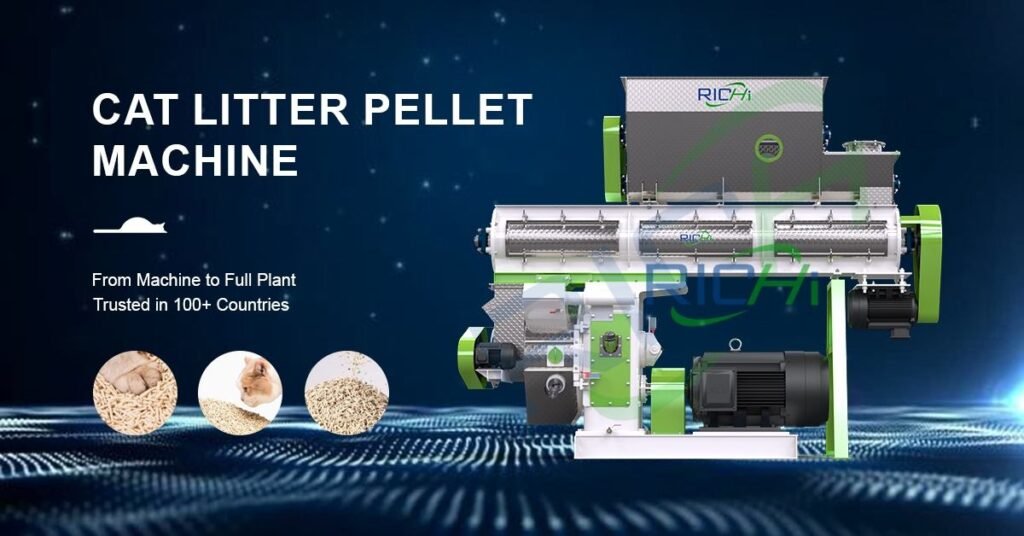
Clumping cat litter has become one of the most popular categories in the modern pet-care market. Compared with traditional non-clumping litter, clumping products can absorb liquid and form compact masses that are easier for cat owners to remove. This makes daily litter-box cleaning more convenient and helps consumers use litter more efficiently.
Although small quantities of clumping litter can be produced with relatively simple equipment, manufacturing it at commercial scale requires much more careful control. Raw material quality, moisture, particle size, granulation, density, clumping strength, dust content, drying, screening, and packaging all influence the final product.
A properly designed cat litter production system integrates these stages into a continuous and efficient manufacturing process. Depending on the product type, the system may be based on bentonite, tofu, wood fiber, corn, cassava, or other absorbent materials.
This article explains how to manufacture clumping cat litter at scale, including raw material selection, formulation, processing technology, equipment selection, quality control, and factory design.
1. What Is Clumping Cat Litter?
Clumping cat litter is designed to absorb urine and form a relatively solid mass after contact with liquid.
The main advantages include:
- Easy removal
- Efficient litter-box cleaning
- Good liquid absorption
- Better odor management
- Reduced need to replace all litter
- Convenient daily maintenance
Bentonite is one of the most common raw materials for clumping cat litter because certain bentonite materials have strong swelling and binding properties.
However, plant-based clumping litter has also become increasingly popular. Tofu, corn, cassava, and other plant fibers can be formulated to produce clumping products.
2. Choose the Right Raw Material
The raw material determines the basic characteristics of the final product.
Common materials for clumping cat litter include:
- Sodium bentonite
- Calcium bentonite
- Soybean residue
- Soybean fiber
- Corn fiber
- Cassava starch
- Wood fiber
- Other plant-based materials
The ideal raw material should have suitable:
- Absorption
- Particle characteristics
- Moisture
- Binding properties
- Availability
- Cost
- Processing performance
Before designing the production line, manufacturers should test representative samples of the raw material.
3. Bentonite for Clumping Cat Litter
Bentonite is widely used in commercial clumping litter.
Its performance depends on mineral composition and processing conditions.
High-quality bentonite-based litter should provide:
- Rapid liquid absorption
- Strong clumping
- Appropriate particle size
- Low dust
- Good odor retention
- Stable storage
The raw mineral may need to be crushed, ground, screened, moisture-adjusted, granulated, dried, and screened before packaging.
The exact process should be adapted to the characteristics of the bentonite deposit.
4. Plant-Based Clumping Cat Litter
Plant-based clumping litter can be produced using materials such as:
- Soybean residue
- Corn fiber
- Cassava
- Pea fiber
- Wood fiber
These materials may require binders to improve clumping.
Starch is commonly considered because it can help particles bind together when exposed to moisture.
A plant-based formula may therefore combine:
Main Fiber + Starch/Binder + Odor-Control Ingredients + Optional Functional Additives
The formulation should balance clumping, absorption, pellet strength, and cost.
5. Test Raw Materials Before Production
Large-scale manufacturing should never begin without raw material testing.
Important tests include:
Moisture Content
Determines drying requirements.
Particle Size
Influences granulation and product texture.
Absorption
Shows the material’s ability to retain liquid.
Swelling or Binding Characteristics
Especially important for bentonite.
Density
Influences packaging and transportation costs.
Clumping Performance
Determines whether the final product can form stable clumps.
Testing helps manufacturers select suitable materials and avoid production problems.
6. Develop the Product Formula
A commercial clumping litter product should have a clearly defined formula.
For bentonite products, the formula may focus primarily on mineral quality and particle distribution.
For plant-based litter, a formula may include:
- Soybean fiber
- Corn fiber
- Starch
- Plant-based binder
- Activated carbon
- Odor-control additives
- Fragrance, if required
The formula should be tested for:
- Clump strength
- Absorption
- Dust
- Pellet durability
- Odor control
- Storage stability
A good formula balances performance with manufacturing cost.
7. Complete Clumping Cat Litter Production Process
A typical plant-based clumping litter process can be organized as:
Raw Material Receiving
↓
Cleaning
↓
Crushing
↓
Grinding
↓
Drying
↓
Batching
↓
Mixing
↓
Moisture Adjustment
↓
Pelletizing/Granulation
↓
Drying
↓
Cooling
↓
Screening
↓
Odor-Control Treatment
↓
Packaging
The process for bentonite litter may be different.
The production flow should therefore be customized according to the selected raw material.
8. Step 1: Raw Material Receiving
Raw materials arrive at the factory by truck or other transportation.
A receiving system may include:
- Receiving hopper
- Conveyor
- Feeder
- Storage bin
- Dust collection system
For a large factory, automatic receiving reduces manual handling and improves production efficiency.
The receiving area should also provide protection against rain and contamination.
9. Step 2: Cleaning
Foreign materials should be removed before processing.
A cleaning system can remove:
- Stones
- Metal
- Plastic
- Soil
- Oversized material
Magnetic separators can remove ferrous metal.
Screens can separate oversized particles.
Cleaning protects crushers, grinders, pellet mills, and other equipment from damage.
10. Step 3: Crushing and Grinding
Large plant-based materials need to be reduced in size.
A crusher can process:
- Wood chips
- Bamboo
- Large fibers
- Agricultural residues
A hammer mill can then reduce the material to a more uniform size.
For plant-based clumping litter, appropriate particle size helps improve:
- Mixing
- Pellet formation
- Clump strength
- Product consistency
However, excessive grinding should be avoided because it increases energy consumption.
11. Step 4: Drying
Moisture control is critical to commercial clumping litter production.
Plant materials can enter the factory with high and variable moisture levels.
A dryer can reduce the moisture to a suitable range.
The drying system should provide:
- Uniform heat transfer
- Stable airflow
- Controlled residence time
- Appropriate final moisture
Rotary dryers are often suitable for continuous industrial processing.
Drying should not be excessive because over-drying wastes energy and may affect pelletizing.
12. Step 5: Batching
If several ingredients are used, accurate batching is required.
For example:
- 80% main plant fiber
- 15% starch or binder
- 5% functional ingredients
The actual formula should be determined through product testing rather than relying on a generic recipe.
Automatic batching equipment can improve:
- Formula accuracy
- Production consistency
- Labor efficiency
- Traceability
Large production facilities can integrate batching with PLC control.
13. Step 6: Mixing
After batching, the ingredients must be thoroughly mixed.
A commercial mixer distributes the materials evenly.
This is especially important when adding:
- Starch
- Binder
- Odor-control additives
- Activated carbon
- Fragrance
A homogeneous mixture ensures that the final product has more consistent clumping and odor-control performance.
14. Step 7: Moisture Adjustment
Before forming, moisture should be checked.
A controlled spraying system can add water if necessary.
Moisture affects:
- Pellet formation
- Density
- Strength
- Drying requirements
- Final absorption
If the material is too dry, pellets may not form properly.
If it is too wet, pellets can become soft and difficult to dry.
Therefore, moisture adjustment should be precise and uniform.
15. Step 8: Pelletizing or Granulation
This is the main forming stage.
Depending on the product, manufacturers can use:
- Pellet mill
- Granulator
- Other particle-forming equipment
A pellet mill compresses prepared material through a die.
The resulting pellets can be cut to the desired length.
A granulator may be preferred for products requiring different particle shapes.
The forming process influences the final litter’s:
- Density
- Particle size
- Strength
- Absorption
- Dust
https://pelletisingmachine.com/cat-litter-pellet-machine
16. Control Particle Size
Particle size is particularly important for clumping litter.
Very fine particles can create more dust.
Very large particles may affect:
- Absorption speed
- Clumping
- Cat acceptance
- Tracking
A screening system can separate particles into different size grades.
Manufacturers may develop several products with different particle sizes for different markets.
17. Control Pellet Density
Density influences how quickly liquid enters the litter particles.
If pellets are extremely dense, absorption can be slower.
If pellets are too loose, they may break easily.
Density depends on:
- Raw material
- Moisture
- Binder
- Compression
- Die specifications
- Pellet mill settings
The optimum density should be established through actual absorption and clumping tests.
18. Step 9: Drying the Formed Product
Freshly formed plant-based pellets may contain excess moisture.
A dryer can stabilize the product.
Important drying parameters include:
- Temperature
- Airflow
- Residence time
- Feed rate
- Initial moisture
- Target moisture
The objective is to remove sufficient moisture while maintaining pellet integrity.
Efficient drying is particularly important at large scale because energy consumption can significantly affect operating costs.
19. Step 10: Cooling
After drying, the litter should be cooled.
A cooler reduces the product temperature and prepares it for screening.
Cooling helps:
- Prevent condensation
- Improve storage stability
- Protect packaging
- Reduce product temperature
- Improve handling
The cooler should be properly matched to production capacity.
20. Step 11: Screening
Screening is essential for producing uniform clumping litter.
The screen separates:
- Fine powder
- Broken pellets
- Oversized particles
- Finished particles
A vibrating screen or rotary screen can be used.
Good screening improves:
- Appearance
- Particle consistency
- Dust performance
- Packaging accuracy
Suitable fines can potentially be recycled.
21. Step 12: Improve Clumping Strength
The main purpose of clumping litter is to form stable clumps after absorbing liquid.
Clumping performance depends on:
- Raw material
- Binder
- Particle size
- Moisture
- Density
- Forming pressure
Manufacturers should test clumps for:
- Formation speed
- Strength
- Breakage
- Liquid retention
- Ease of removal
A strong clump should remain intact during scooping.
22. Step 13: Odor Control
Liquid absorption alone does not guarantee good odor control.
Manufacturers may use suitable additives such as:
- Activated carbon
- Mineral adsorbents
- Plant-derived odor-control ingredients
These additives can be incorporated during mixing or applied through a coating system.
The final product should be tested under practical conditions to evaluate odor-management performance.
23. Step 14: Dust Control
Low dust is an important quality characteristic.
Dust can come from:
- Grinding
- Pelletizing
- Drying
- Cooling
- Screening
- Conveying
- Packaging
Dust reduction strategies include:
- Optimizing raw material grinding.
- Improving pellet durability.
- Screening out fines.
- Reducing unnecessary mechanical impact.
- Installing effective dust collectors.
A professional factory should include dust collection at major dust-generating points.
24. Step 15: Packaging
After quality inspection, the finished litter is packaged.
Typical packages include:
- 5 kg
- 6 kg
- 10 kg
- 15 kg
An automatic packaging machine can:
- Weigh the litter.
- Fill bags.
- Seal bags.
- Print batch information.
- Convey finished packages.
Moisture-resistant packaging is especially important for clumping products.
25. What Equipment Is Needed?
A large-scale clumping cat litter production system may contain the following equipment.
Raw Material Section
- Receiving hopper
- Cleaner
- Crusher
- Magnetic separator
- Storage bin
Grinding Section
- Hammer mill
- Dust collector
- Cyclone
Conditioning Section
- Dryer
- Batching system
- Mixer
- Water spraying system
Forming Section
- Pellet mill
- Granulator
- Forced feeder
Post-Processing Section
- Dryer
- Cooler
- Vibrating screen
- Coating machine
Packaging Section
- Automatic weighing machine
- Bagging machine
- Sealing machine
- Conveyor
Control Section
- PLC
- Electrical control cabinet
- Sensors
26. How to Design a Cat Litter Production System
A commercial cat litter production system should be designed according to several key parameters.
Raw Material
What material will be processed?
Capacity
How many tons per hour are required?
Product Size
What particle diameter is required?
Formula
How much binder and odor-control material will be used?
Moisture
What are the initial and target moisture levels?
Packaging
What package sizes will be used?
Automation
How much production automation is required?
These factors determine the final machinery configuration.
27. Small-Scale vs. Large-Scale Production
A small-scale production system may use:
Grinder → Mixer → Pellet Mill → Dryer → Cooler → Screen → Packaging
A large commercial system may include:
Raw Material Receiving → Cleaning → Crushing → Grinding → Drying → Batching → Mixing → Conditioning → Pelletizing → Drying → Cooling → Screening → Coating → Packaging → Palletizing
The larger system provides greater automation and production capacity.
However, larger capacity also requires greater investment and more sophisticated management.
28. How to Improve Production Efficiency
Manufacturers can improve efficiency by optimizing the entire production system.
Match Equipment Capacity
Avoid bottlenecks between machines.
Control Moisture
Stable moisture improves pelletizing and drying.
Optimize Grinding
Do not grind material finer than necessary.
Automate Batching
Accurate batching reduces formulation errors.
Recycle Suitable Fines
Recycling can reduce material waste.
Improve Material Flow
Efficient conveyors reduce unnecessary handling.
Maintain Equipment
Preventive maintenance reduces downtime.
29. How to Reduce Production Costs
Large-scale production requires careful cost management.
Major cost factors include:
- Raw materials
- Electricity
- Heating fuel
- Labor
- Packaging
- Maintenance
- Transportation
Manufacturers can reduce costs by:
- Sourcing local raw materials
- Improving dryer efficiency
- Optimizing equipment capacity
- Reducing dust losses
- Recycling suitable fines
- Automating packaging
- Maintaining machines properly
Energy efficiency is particularly important because drying can consume significant amounts of heat.
30. Quality Control for Large-Scale Clumping Litter
A professional factory should establish quality standards for every production stage.
Raw Material
Test moisture, cleanliness, and composition.
Process
Monitor grinding, mixing, moisture, and forming conditions.
Finished Product
Test:
- Particle size
- Moisture
- Density
- Absorption
- Clump strength
- Dust
- Durability
- Odor control
Regular testing helps maintain stable product quality across different production batches.
31. How to Build a Commercial Factory
Before building a factory, entrepreneurs should determine:
- Target market
- Product type
- Raw material source
- Production capacity
- Product specifications
- Packaging format
- Factory area
- Energy source
- Automation requirements
- Investment budget
A pilot production test is highly recommended.
It can verify whether the selected raw material and formula can produce the required product before large-scale equipment is purchased.
32. RICHI Cat Litter Production System
RICHI Pellet Mill provides customized equipment and turnkey engineering solutions for manufacturers developing clumping cat litter production projects.
A complete cat litter production system can be designed according to:
- Bentonite or plant-based raw materials
- Raw material moisture
- Production capacity
- Product size
- Clumping requirements
- Formula
- Drying conditions
- Packaging requirements
- Factory layout
A typical plant-based line may include:
Raw Material Preparation → Crushing → Grinding → Drying → Batching → Mixing → Moisture Adjustment → Pelletizing → Drying → Cooling → Screening → Coating → Packaging
RICHI can provide customized production line design, equipment manufacturing, overseas transportation and customs clearance, on-site installation and commissioning, operator training, spare parts supply, and long-term technical support.
This turnkey approach allows the equipment, process flow, and factory layout to be designed as one integrated system.
33. Why Integrated Production Matters
A clumping cat litter factory contains multiple interconnected processes.
For example, if the grinder produces inconsistent particles, pellet quality can become unstable.
If the dryer cannot handle the output of the pellet mill, production capacity will be restricted.
If the screen is inefficient, excessive fines may enter the packaging stage.
If the packaging machine is too slow, finished products may accumulate.
Therefore, the entire cat litter production system should be balanced.
Equipment capacity, material flow, process parameters, and automation should be considered together.
34. Maintenance of Production Equipment
Regular maintenance is necessary for stable large-scale production.
Important maintenance tasks include:
- Inspecting pellet mill rollers
- Checking dies
- Lubricating bearings
- Inspecting conveyors
- Cleaning screens
- Checking dryer components
- Cleaning dust collectors
- Inspecting motors
- Replacing worn parts
Critical spare parts should be stored in advance.
Preventive maintenance can reduce unexpected downtime and improve equipment service life.
35. Future Trends in Clumping Cat Litter
The clumping cat litter market is likely to continue developing toward products with improved convenience and performance.
Potential trends include:
- Plant-based clumping litter
- Low-dust products
- Lightweight litter
- Stronger clumping
- Faster absorption
- Improved odor control
- Biodegradable materials
- Energy-efficient manufacturing
- Automated production
- Smart factory management
Manufacturers that can combine performance with efficient production may have stronger long-term competitiveness.
Conclusion
Making clumping cat litter at scale requires much more than simply compressing raw materials into pellets. A successful commercial product depends on high-quality raw materials, optimized formulation, accurate moisture control, suitable particle size, effective pelletizing or granulation, efficient drying, cooling, screening, odor treatment, dust control, and reliable packaging.
A typical plant-based production process can be summarized as:
Raw Materials → Cleaning → Crushing → Grinding → Drying → Batching → Mixing → Moisture Adjustment → Pelletizing/Granulation → Drying → Cooling → Screening → Odor Treatment → Packaging
Bentonite-based clumping litter follows a somewhat different process, with mineral preparation and granulation playing a central role.
For large-scale manufacturing, the most important consideration is to build a balanced cat litter production system in which every machine works efficiently with the others. Grinding capacity should match pelletizing capacity, dryers should handle the required throughput, screening systems should maintain particle-size consistency, and packaging equipment should keep pace with finished-product output.
RICHI can provide customized equipment and turnkey production line solutions according to raw materials, capacity, product specifications, and factory layout. Services can cover production line design, equipment manufacturing, transportation, installation, commissioning, operator training, and long-term technical support.
Ultimately, the key to successful large-scale clumping cat litter production is process integration. When raw materials, formulation, equipment, moisture, particle size, drying, screening, and quality control are properly coordinated, manufacturers can produce consistent clumping litter efficiently, control production costs, and build products that meet the increasingly demanding expectations of the global pet-care market.