
 +86 18574103366
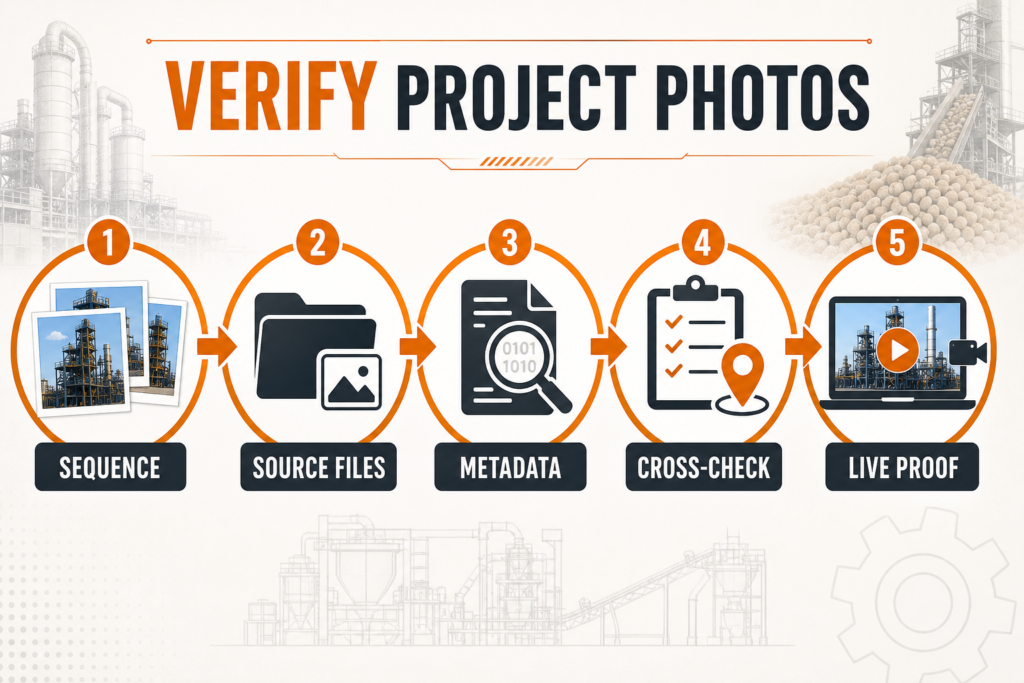
Project photographs can be useful evidence when evaluating a pellet machine supplier, but a polished gallery is not proof by itself. The practical question is not whether a photograph looks convincing. It is whether the supplier can connect that photograph to a specific project, a credible sequence of work, original files, identifiable equipment, and a live organization that can explain what happened before and after the shutter was pressed.
The strongest review therefore treats photographs as one layer in a wider evidence chain. A buyer should test consistency across the images, the proposal, process design, equipment list, installation timeline, operating conditions, and live conversations with the supplier. No single clue proves authenticity, and missing metadata does not automatically prove deception. What matters is whether several independent checks point in the same direction.
Start with a sequence, not a showcase image
A genuine industrial project normally creates a visual trail. The supplier may have photographs from civil preparation, equipment fabrication, packing, container loading, site installation, cable routing, commissioning, and early operation. Not every stage will be documented perfectly, especially on an older project, but a sequence is much harder to misrepresent than one attractive finished-plant image.
Ask the supplier to arrange the files in chronological order and explain what changes from one frame to the next. Look for stable features such as the same building columns, floor openings, roof structure, wall panels, nearby roads, equipment orientation, or distinctive site constraints. A real sequence often contains ordinary details that marketing galleries remove: protective wrapping, temporary supports, unfinished platforms, open cable trays, construction dust, spare fasteners, and workers solving access problems.
Continuity matters more than visual quality. A set of professional photographs can be legitimate, while phone images can be misleading. The useful question is whether the physical scene develops logically. If a finished line appears without any related fabrication, loading, installation, or commissioning material, request more context before relying on it.
Request original source files
Website images are commonly resized, compressed, renamed, and stripped of metadata by content-management systems. For that reason, downloading a picture from a supplier’s web page and examining it may reveal very little. Ask for several original camera or phone files from the same project rather than relying on the web versions.
- Request files at their original dimensions, not screenshots placed in a document.
- Ask for adjacent photographs taken before and after the published frame.
- Compare naming patterns, timestamps, dimensions, device information, and editing history where available.
- Ask why any important file has been heavily cropped, exported repeatedly, or supplied only through a social-media screenshot.
Metadata should be treated as supporting evidence rather than a verdict. It can be removed during normal sharing or intentionally altered. Conversely, consistent metadata across a large group of original files can strengthen the case when it agrees with the claimed project timeline and location. The supplier should be able to explain gaps without becoming evasive.
The logic behind this check is consistent with NIST guidance on preserving digital evidence, which emphasizes documenting the original source of a digital image and protecting file integrity. A commercial supplier audit is not a forensic investigation, but source provenance is still a useful principle when you verify pellet machine supplier project photos.
Cross-check visible equipment against the proposal
A project photograph becomes more informative when it can be connected to an equipment list. Compare the visible machines with the model types, capacities, process route, and layout discussed in the current proposal. Do not expect an old project to match your planned line exactly. Instead, ask whether the supplier understands the differences.
For example, a photograph claimed to show an animal feed project should contain a process arrangement consistent with the described raw materials and finished products. Storage, grinding, mixing, conditioning, pelleting, cooling, screening, conveying, and packing should form a physically plausible flow. The exact machines will vary, but transfer points and elevations should make engineering sense. If the salesperson cannot explain where material enters, changes condition, and exits, the image may not represent experience that the current team can actually apply.
Also compare fabrication details. Look at paint color only as a weak clue because equipment can be repainted or supplied under different branding. Stronger clues include frame geometry, access-door design, gearbox orientation, guard construction, platform details, conveyor type, control-cabinet arrangement, and equipment nameplates. Ask for close-up images of identifiers, but remember that a nameplate proves ownership of a machine more readily than ownership of the complete project.
Test the project story for operational depth
Authentic project experience usually leaves operational knowledge behind. Ask the supplier to describe the raw material, target product, line configuration, commissioning challenge, and changes made after initial operation. The answer should distinguish what was designed, what was delivered, and what was later adjusted.
Useful questions include: What moisture variability had to be managed? Why was a particular conveying route selected? Which access point was difficult during installation? What interlock was added or revised? How was operator training organized? Which wear items required the closest monitoring during early production? These questions do not require the supplier to disclose a customer’s confidential production data. They test whether someone can connect the photograph to real engineering decisions.
Be cautious when every answer is a sales claim. Real projects involve constraints and trade-offs. A compact layout may reduce building footprint but make maintenance access more demanding. A high degree of automation may improve process consistency but require stronger electrical support and operator discipline. An authentic explanation should acknowledge such boundaries instead of presenting the project as flawless.
Use reverse-image and web consistency checks carefully
A reverse-image search can reveal that the same photograph appears on unrelated websites, older catalogues, stock libraries, or another manufacturer’s project page. That is a meaningful warning, but interpretation still requires care. Distributors may legitimately reuse a manufacturer’s images, project owners may publish the same installation, and copied websites may steal material from the original source.
Compare publication dates, image resolution, surrounding text, and the availability of related photos. The earliest indexed page is not necessarily the creator, but a supplier that can provide original files, a coherent sequence, and project documentation has a stronger claim than a site displaying one compressed copy. Search distinctive image details and unusual phrases from the project description rather than relying on one automated result.
Ask for live proof that is difficult to stage
When the project is important to a purchasing decision, request a live video call. This does not always mean contacting the end customer; confidentiality or time-zone limitations may prevent that. The supplier can instead walk through its factory, show archived project materials, open a project folder, or connect an engineer who participated in design or commissioning.
Make the request specific and reasonable. Ask the presenter to show a named item, move from one part of the workshop to another, display the current date beside a project drawing, or open several adjacent files from the same installation. A prerecorded promotional tour cannot answer follow-up questions. A live exchange also reveals whether the sales, engineering, manufacturing, and after-sales teams share the same project knowledge.
Compare photos with documents, without over-trusting documents
Supporting documents may include layout drawings, packing lists, equipment schedules, commissioning checklists, installation records, manuals, and redacted delivery paperwork. Each item should agree with the visible project at a practical level. Dates should form a plausible order, equipment quantities should not conflict, and the described process should resemble the photographs.
Documents can also be altered, so use them as cross-checks rather than absolute proof. Redaction is normal when customer names, prices, or contact details are confidential. What matters is whether the supplier can provide enough consistent technical detail to support its claim while explaining what cannot be disclosed.
A practical evidence-rating method
Instead of labeling a photograph simply real or fake, rate the evidence in layers. A weak case may consist only of a web image and a broad location claim. A developing case adds original files and a credible sequence. A strong case connects those files to equipment lists, engineering explanations, project records, and live proof. The purpose is not to conduct a forensic investigation of every image. It is to decide how much commercial and technical confidence the gallery deserves.
- Image continuity: Do multiple photographs show the same site developing over time?
- File provenance: Are original files or adjacent frames available?
- Technical consistency: Does visible equipment match the claimed process and project scope?
- Organizational memory: Can engineers explain constraints, decisions, and commissioning work?
- Independent confirmation: Do documents, live video, public information, or a permitted reference support the same story?
Warning signs that justify a deeper review
Warning signs include inconsistent equipment branding within a supposedly single-supplier project, project descriptions that change between conversations, impossible or unexplained timelines, refusal to provide any adjacent images, staff who cannot identify basic process stages, and galleries repeated across unrelated locations. Another concern is a portfolio with many finished plants but no evidence of fabrication, packing, installation, or commissioning capability.
None of these signs should be judged in isolation. Older projects may have incomplete records, websites may be managed poorly, and customer confidentiality may be strict. The supplier’s response is often as important as the missing evidence. A credible organization should state the limitation, offer an alternative check, and avoid turning uncertainty into a fabricated certainty.
How to apply the same test to RICHI Machinery or any supplier
The method should be applied consistently. When reviewing RICHI Machinery, ask for project material relevant to your raw material, product, capacity range, automation level, and destination conditions. Request a sequence rather than a hero image, connect visible equipment to the proposed process, and ask the responsible team to explain project-specific constraints. The same standard should be used for every shortlisted supplier.
The final purchasing decision should not rest on photographs alone. Combine visual evidence with factory capability, engineering response quality, contract scope, component transparency, commissioning arrangements, spare-parts planning, and after-sales procedures. Authentic project photos are valuable because they support that wider assessment. They are not a substitute for it.
Final buyer takeaway
You can judge project-photo authenticity more reliably by building an evidence chain: examine continuity, request source files, review metadata cautiously, cross-check equipment and documents, test the project story, and seek live proof. Confidence rises when independent details agree and the supplier can explain both achievements and limitations. If the evidence remains thin, treat the gallery as marketing material and keep due diligence open.