
 +86 18574103366
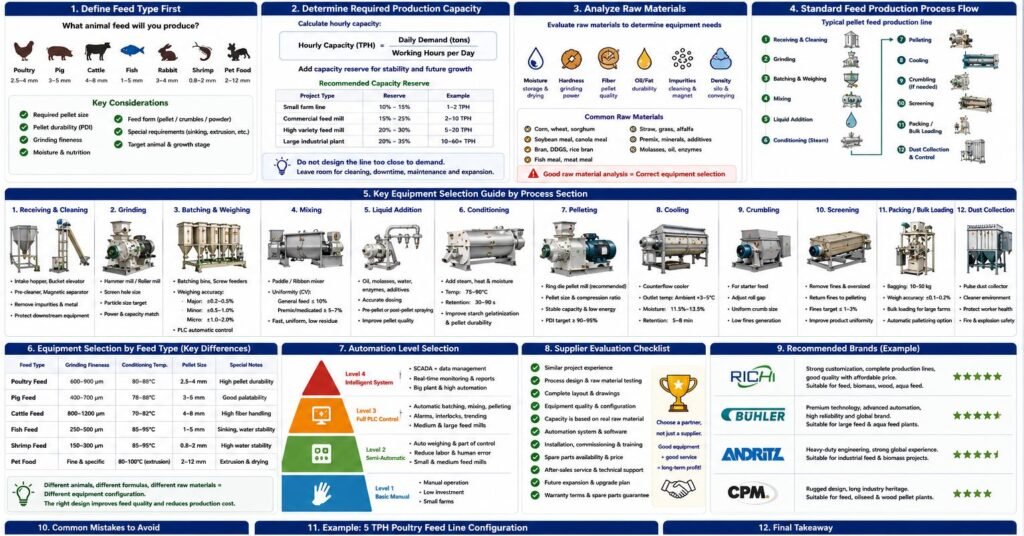
Choosing equipment for an animal feed production line is one of the most important decisions in a feed mill project. The equipment configuration directly affects production capacity, feed quality, pellet durability, energy consumption, labor cost, maintenance cost, and long-term profitability.
Many investors make one common mistake: they choose machines only by price or rated capacity. In reality, a good feed production line must be designed according to raw material characteristics, animal species, feed formula, pellet size, moisture requirements, production capacity, factory layout, automation level, local labor conditions, and future expansion plans.
A suitable animal feed production line should not only produce feed. It should produce stable, safe, uniform, and cost-effective feed at the required capacity.
1- Define the Feed Type First
Before choosing equipment, the first question is:
What type of animal feed will the line produce?
Different animals require different grinding fineness, mixing accuracy, conditioning temperature, pellet size, pellet durability, and cooling control.
Common animal feed categories
| Feed Type | Typical Pellet Diameter | Key Equipment Requirement |
|---|---|---|
| Poultry feed | 2.5–4.0 mm | Efficient grinding, mixing, pelleting, cooling |
| Pig feed | 3.0–5.0 mm | Fine grinding, good conditioning, stable pellet quality |
| Cattle feed | 4.0–8.0 mm | Strong mixer, larger pellet size, fiber handling |
| Sheep and goat feed | 3.0–6.0 mm | Fiber processing, uniform mixing |
| Rabbit feed | 3.0–4.0 mm | High pellet durability and low fines |
| Fish feed | 1.0–5.0 mm | Fine grinding, strong conditioning or extrusion |
| Shrimp feed | 0.8–2.0 mm | Ultra-fine grinding, high water stability |
| Pet food | 2.0–12.0 mm | Usually requires extrusion and drying |
| Premix feed | Powder form | High mixing accuracy, no pelleting required |
For example, a poultry feed line and an aquatic feed line may both be called “feed production lines,” but their equipment configuration is very different. Aquatic feed usually requires finer grinding, higher conditioning intensity, better drying or extrusion control, and higher water stability.
2- Determine the Required Production Capacity
Capacity is the foundation of equipment selection. The production line must match both current demand and future growth.
Common capacity levels
| Production Scale | Typical Capacity | Suitable User |
|---|---|---|
| Small farm feed line | 0.5–2 TPH | Farms, small cooperatives |
| Small commercial feed mill | 2–5 TPH | Local feed suppliers |
| Medium feed mill | 5–10 TPH | Regional feed manufacturers |
| Large industrial feed mill | 10–30 TPH | Commercial feed companies |
| Large-scale feed factory | 30–60 TPH or more | Group enterprises and large integrators |
TPH means tons per hour.
Capacity selection formula
Daily feed demand can be calculated as:
Required hourly capacity = daily feed demand ÷ available production hours
Example:
If a feed mill needs to produce 80 tons per day and operates 10 hours per day:
80 tons ÷ 10 hours = 8 TPH
In this case, the recommended equipment capacity should not be exactly 8 TPH. It is better to design a line of 8–10 TPH to leave room for cleaning, formula change, maintenance, and capacity fluctuation.
Recommended capacity reserve
| Project Type | Recommended Capacity Reserve |
|---|---|
| Farm-use feed line | 10%–15% |
| Commercial feed mill | 15%–25% |
| High-variety feed mill | 20%–30% |
| Large industrial project | 20%–35% |
If capacity is designed too close to the required output, the plant will frequently operate under overload, which increases downtime, energy consumption, and equipment wear.
3- Analyze Raw Material Characteristics
Raw materials determine equipment strength, process configuration, and energy consumption.
Key raw material factors
| Raw Material Factor | Why It Matters | Equipment Impact |
|---|---|---|
| Moisture | Affects storage, grinding, pelleting, cooling | May require drying or moisture control |
| Hardness | Affects grinding energy | Determines hammer mill power |
| Fiber content | Affects flowability and pellet quality | Requires stronger grinding and conditioning |
| Oil/fat content | Affects pellet durability | May need post-pellet oil spraying |
| Bulk density | Affects bin and conveyor design | Determines silo volume and conveyor capacity |
| Particle size | Affects grinding requirement | Determines pre-cleaning and crusher type |
| Impurities | Affects equipment safety | Requires cleaning, magnetic separation, screening |
| Formula variability | Affects process flexibility | Requires flexible batching and control system |
Example raw material influence
| Raw Material Type | Equipment Selection Consideration |
|---|---|
| Corn, wheat, sorghum | Standard hammer mill or roller mill |
| Soybean meal | Normal grinding and batching |
| Bran, DDGS, fiber materials | Flowability and dust control required |
| Grass, alfalfa, straw | Pre-crushing and strong fiber handling |
| Oil-rich materials | Pellet durability control required |
| Fish meal and animal protein | Odor, hygiene, and cross-contamination control |
| Premix and micro-ingredients | High-accuracy dosing and mixing required |
If the raw material contains many impurities, the line must include cleaning equipment such as screens, magnetic separators, and dust collection systems. Skipping these machines may reduce initial investment but can cause serious long-term problems, including hammer mill damage, die blockage, bearing failure, and feed contamination.
4- Choose the Correct Process Flow
A standard animal feed production line usually includes the following sections:
1- Raw material receiving and cleaning
2- Crushing or grinding
3- Batching and weighing
4- Mixing
5- Liquid addition
6- Pelleting or extrusion
7- Cooling
8- Crumbling, if needed
9- Screening
10- Packaging or bulk loading
11- Dust collection and control system
12- Electrical automation system
Standard pellet feed production process
| Process Section | Main Function | Main Equipment |
|---|---|---|
| Receiving | Accept raw materials | Intake hopper, conveyor, elevator |
| Cleaning | Remove impurities and metal | Pre-cleaner, magnetic separator |
| Grinding | Reduce particle size | Hammer mill, roller mill |
| Batching | Weigh ingredients accurately | Batching scale, silos, screw conveyors |
| Mixing | Create uniform feed mixture | Ribbon mixer or paddle mixer |
| Conditioning | Add steam and heat | Conditioner |
| Pelleting | Form pellets | Ring die pellet mill |
| Cooling | Reduce temperature and moisture | Counterflow cooler |
| Crumbling | Produce small pellets or crumbs | Pellet crumbler |
| Screening | Remove fines and oversized particles | Rotary screener or vibrating screen |
| Packing | Weigh and bag feed | Automatic packing machine |
| Dust collection | Control dust and improve safety | Pulse dust collector |
5- Equipment Selection by Production Section
5.1- Raw Material Receiving and Cleaning Equipment
Main equipment
*- Intake hopper
*- Bucket elevator
*- Screw conveyor or chain conveyor
*- Pre-cleaning screen
*- Magnetic separator
*- Dust collector
Selection points
| Equipment | Selection Criteria |
|---|---|
| Intake hopper | Must match truck unloading speed and raw material type |
| Bucket elevator | Capacity should be 10%–20% higher than line capacity |
| Pre-cleaner | Required if raw materials contain stones, straw, rope, or large impurities |
| Magnetic separator | Strongly recommended before grinding and pelleting |
| Dust collector | Necessary for worker safety and environmental control |
Practical recommendation
For commercial feed mills, cleaning equipment should not be omitted. A small investment in cleaning and magnetic separation can protect expensive equipment such as hammer mills, pellet mills, dies, rollers, and bearings.
5.2- Grinding Equipment
Grinding is one of the most important steps in feed production. It affects digestibility, mixing uniformity, pellet quality, energy consumption, and capacity.
Hammer mill vs roller mill
| Equipment | Advantages | Suitable Application |
|---|---|---|
| Hammer mill | Flexible, widely used, suitable for many raw materials | Poultry, pig, cattle, general feed |
| Roller mill | More uniform particle size, lower fines in some cases | Corn-based feed, coarse grinding |
| Ultra-fine pulverizer | Very fine particle size | Aquafeed, shrimp feed, pet food |
Recommended particle size
| Feed Type | Suggested Particle Size |
|---|---|
| Broiler feed | 600–900 µm |
| Layer feed | 700–1,000 µm |
| Piglet feed | 400–600 µm |
| Grower-finisher pig feed | 500–700 µm |
| Cattle feed | 800–1,200 µm |
| Fish feed | 250–500 µm |
| Shrimp feed | 150–300 µm |
Key selection factors
*- Raw material hardness
*- Target particle size
*- Required capacity
*- Screen hole size
*- Motor power
*- Dust collection requirement
*- Maintenance accessibility
*- Noise and vibration control
For most standard animal feed lines, a hammer mill is the most common and practical choice. For high-end aquatic feed, ultra-fine grinding equipment is often required.
5.3- Batching and Weighing Equipment
Batching accuracy directly affects feed nutrition, animal performance, and production cost.
Main equipment
*- Ingredient bins
*- Screw feeders
*- Batching scale
*- Micro-ingredient scale
*- Liquid weighing system
*- PLC control system
Recommended weighing accuracy
| Ingredient Type | Recommended Accuracy |
|---|---|
| Major ingredients | ±0.2%–0.5% |
| Minor ingredients | ±0.5%–1.0% |
| Micro-ingredients | ±1.0%–2.0% |
| Liquid ingredients | ±0.5%–1.0% |
Selection recommendation
For small feed lines, manual micro-ingredient addition may be acceptable. For medium and large commercial feed mills, automatic batching and micro-dosing systems are strongly recommended to reduce formula errors and labor dependence.
5.4- Mixing Equipment
Mixing determines whether nutrients, additives, minerals, vitamins, and medicines are evenly distributed.
Common mixer types
| Mixer Type | Features | Suitable Use |
|---|---|---|
| Single-shaft paddle mixer | Fast mixing, good uniformity | Medium and large feed mills |
| Double-shaft paddle mixer | High speed, high uniformity | Large and high-efficiency feed mills |
| Ribbon mixer | Simple structure, cost-effective | Small and medium feed lines |
| Vertical mixer | Low cost, small footprint | Small farms, low-capacity use |
Mixing uniformity target
| Feed Product | Recommended CV |
|---|---|
| General complete feed | ≤ 10% |
| Premix or medicated feed | ≤ 5%–7% |
| Aquafeed and young animal feed | ≤ 5%–8% |
CV means coefficient of variation. A lower CV indicates better mixing uniformity.
Selection points
*- Batch size
*- Mixing time
*- Discharge speed
*- Residue level
*- Liquid addition capability
*- Cleanability
*- Cross-contamination risk
For commercial feed production, horizontal paddle mixers are usually preferred because they provide faster mixing, better uniformity, and easier automation.
5.5- Liquid Addition Equipment
Liquid ingredients may include oil, molasses, water, enzymes, amino acid solutions, or other additives.
Selection points
| Liquid Type | Equipment Requirement |
|---|---|
| Oil/fat | Metering pump, spray nozzle, flow meter |
| Molasses | Heating and insulated pipeline may be needed |
| Water | Accurate dosing and anti-clogging nozzles |
| Enzyme solution | Low-temperature protection and precise dosing |
| Post-pellet oil | Coating machine or spraying system |
Engineering advice
If the formula requires high fat addition, do not add all oil before pelleting. Excessive mixer-added oil can reduce pellet durability. A better solution is:
*- Add limited oil in the mixer.
*- Apply the remaining oil after pelleting by post-pellet coating.
5.6- Pellet Mill Selection
The pellet mill is the core machine of a pellet feed production line. It strongly affects capacity, pellet durability, energy consumption, and equipment maintenance cost.
Flat die vs ring die pellet mill
| Pellet Mill Type | Advantages | Suitable Use |
|---|---|---|
| Flat die pellet mill | Low cost, simple operation | Small farm use, experimental production |
| Ring die pellet mill | High capacity, stable quality, industrial use | Commercial feed mills and large farms |
For commercial animal feed production, a ring die pellet mill is normally recommended.
Key selection factors
| Factor | Selection Requirement |
|---|---|
| Capacity | Match target TPH with 15%–25% reserve |
| Pellet diameter | Match animal type and growth stage |
| Die compression ratio | Match formula and raw material |
| Motor power | Match capacity and die resistance |
| Transmission system | Gear drive or belt drive depending on design |
| Bearing and lubrication | Must support long continuous operation |
| Roller adjustment | Easy and accurate adjustment |
| Safety protection | Overload protection and temperature monitoring |
| Automation | Load control and process monitoring recommended |
Typical pellet diameter reference
| Animal Type | Common Pellet Diameter |
|---|---|
| Chick starter feed | 2.0–2.5 mm crumbs |
| Broiler grower feed | 3.0–4.0 mm |
| Layer feed | 3.0–4.0 mm |
| Piglet feed | 2.5–3.5 mm |
| Grower-finisher pig feed | 3.5–5.0 mm |
| Cattle feed | 5.0–8.0 mm |
| Sheep/goat feed | 4.0–6.0 mm |
| Rabbit feed | 3.0–4.0 mm |
| Fish feed | 1.0–5.0 mm |
Die compression ratio reference
| Feed Type | Suggested Compression Ratio |
|---|---|
| Poultry feed | 1:8 to 1:12 |
| Pig feed | 1:9 to 1:13 |
| Cattle feed | 1:7 to 1:10 |
| Rabbit feed | 1:10 to 1:14 |
| Sinking fish feed | 1:12 to 1:18 |
| High-fiber feed | Usually requires higher compression |
| High-fat feed | Requires careful die and conditioning design |
5.7- Conditioning Equipment
Conditioning is critical for pellet quality. It uses steam, heat, moisture, and retention time to improve starch gelatinization, protein plasticization, and pellet durability.
Common conditioner types
| Conditioner Type | Application |
|---|---|
| Single-shaft conditioner | Standard feed pellets |
| Double-shaft conditioner | Better mixing and conditioning |
| Long-time conditioner | High-quality feed and aquatic feed |
| Hygienizer | Feed requiring higher hygiene control |
| Expander | Special high-quality feed or high-energy processing |
Recommended conditioning parameters
| Feed Type | Conditioning Temperature | Retention Time |
|---|---|---|
| Poultry feed | 80–88°C | 30–60 s |
| Pig feed | 78–88°C | 40–90 s |
| Cattle feed | 70–82°C | 30–60 s |
| Rabbit feed | 75–85°C | 45–90 s |
| Sinking fish feed | 85–95°C | 60–180 s |
If the customer wants higher pellet durability, better hygiene, or improved feed conversion, the conditioning system should not be undersized.
5.8- Cooling Equipment
Pellets leave the pellet mill hot and moist. Cooling stabilizes the pellet structure and prepares the product for screening and packing.
Recommended equipment
For most pellet feed lines, a counterflow cooler is recommended because it offers efficient and uniform cooling.
Cooling target
| Parameter | Recommended Target |
|---|---|
| Cooler outlet temperature | Ambient temperature + 3–5°C |
| Finished pellet moisture | 11.5%–13.5% for many feeds |
| Moisture deviation | ≤ ±0.5% |
| Retention time | 5–8 min for many standard pellets |
| Fines after cooling | ≤ 1%–2% preferred |
Selection points
*- Line capacity
*- Pellet diameter
*- Pellet temperature
*- Moisture level
*- Bed depth
*- Fan airflow
*- Discharge structure
*- Dust collection
Avoid choosing a cooler that is too small. An undersized cooler can cause hot pellets, condensation, mold risk, bag caking, and poor storage stability.
5.9- Crumbling Equipment
Crumblers are used when the feed is first produced as pellets and then broken into smaller particles, especially for young poultry or young animals.
Application
| Product | Need Crumbler? |
|---|---|
| Broiler starter feed | Yes, often required |
| Piglet feed | Sometimes |
| Layer feed | Usually no |
| Cattle feed | No |
| Fish feed | Usually no |
| Premix feed | No |
Selection points
*- Roll gap adjustment
*- Uniform crumb size
*- Low fines generation
*- Easy maintenance
*- Stable feeding
5.10- Screening Equipment
Screening removes fines and oversized particles to improve final product quality.
Main equipment
*- Rotary screener
*- Vibrating screen
*- Grading screen
Screening purpose
| Screen Function | Benefit |
|---|---|
| Remove fines | Improve feed appearance and reduce dust |
| Remove oversized pellets | Ensure product uniformity |
| Return fines to pelleting | Reduce waste |
| Grade crumbled feed | Produce correct particle size |
Recommended fines targets
| Product | Fines Before Packing |
|---|---|
| Poultry feed pellets | ≤ 2%–3% |
| Pig feed pellets | ≤ 2%–3% |
| Cattle feed pellets | ≤ 3% |
| Aquatic feed pellets | ≤ 1.5%–2.5% |
| Rabbit feed pellets | ≤ 2%–3% |
5.11- Packing and Bulk Loading Equipment
Packaging equipment should be selected according to product type, bag size, labor cost, and sales method.
Packing options
| Packing Type | Suitable Use |
|---|---|
| Manual packing | Small production lines |
| Semi-automatic packing | Small and medium feed mills |
| Automatic weighing and packing | Commercial feed mills |
| Bulk loading system | Large farms and industrial customers |
| Robotic palletizing | Large modern feed factories |
Common bag sizes
| Bag Size | Application |
|---|---|
| 5–10 kg | Retail or pet feed |
| 20–25 kg | Premium feed, export feed |
| 40–50 kg | Common livestock and poultry feed |
| Bulk | Large farms and integrators |
Selection points
*- Weighing accuracy
*- Bagging speed
*- Dust control
*- Bag type
*- Sewing or heat sealing
*- Labor availability
*- Palletizing method
Recommended weighing accuracy for commercial bagging:
±0.1%–0.2% for many automatic bagging systems.
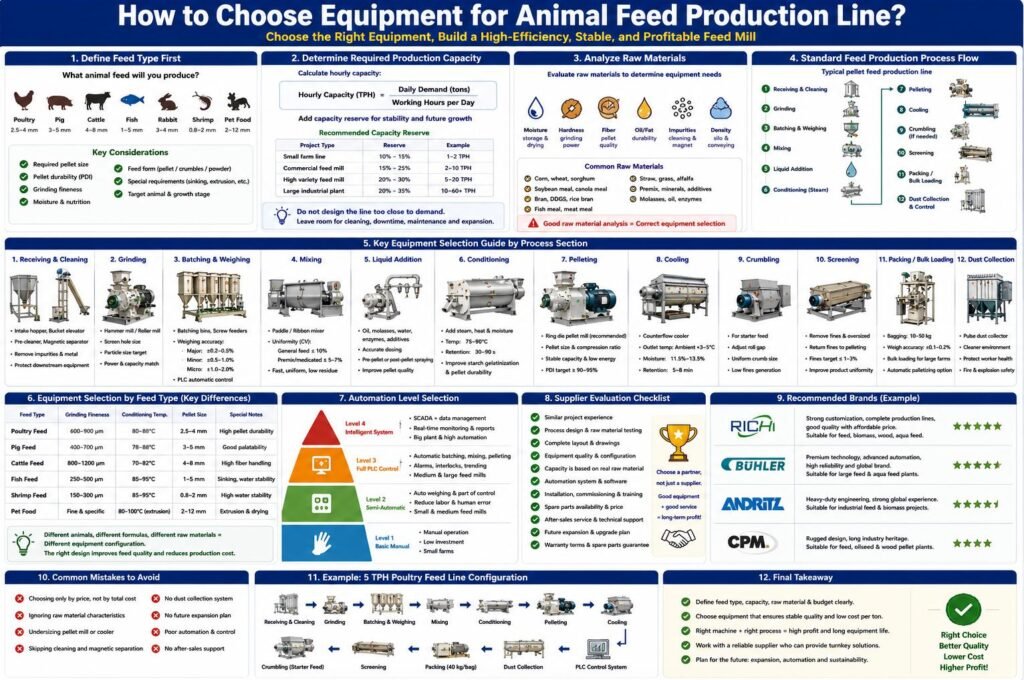
6- Choose the Right Automation Level
Automation level should match production scale, labor cost, quality requirements, and management ability.
Automation levels
| Automation Level | Configuration | Suitable Project |
|---|---|---|
| Basic manual control | Manual feeding, simple control cabinet | Small farm line |
| Semi-automatic | Some automatic weighing and equipment linkage | Small commercial feed mill |
| Full PLC control | Automatic batching, mixing, pelleting, alarms | Medium and large feed mills |
| Intelligent feed mill system | PLC + SCADA + sensors + data reports | Large industrial feed factories |
Recommended automation functions
*- Formula management
*- Automatic batching
*- Micro-ingredient control
*- Mixer discharge control
*- Pellet mill load control
*- Conditioner temperature monitoring
*- Cooler temperature and moisture control
*- Bagging weight feedback
*- Alarm and fault recording
*- Production data report
Automation reduces human error, improves traceability, and stabilizes product quality.
7- Equipment Selection by Capacity
7.1- 1–2 TPH small feed pellet line
Recommended configuration:
*- Raw material receiving hopper
*- Hammer mill
*- Horizontal mixer
*- Ring die pellet mill or small pellet mill
*- Counterflow cooler
*- Simple screener
*- Semi-automatic packing machine
*- Basic dust collector
Suitable for:
*- Farms
*- Small feed suppliers
*- Local livestock cooperatives
7.2- 3–5 TPH commercial feed line
Recommended configuration:
*- Intake and cleaning system
*- Hammer mill
*- Batching bins and automatic scale
*- Paddle mixer
*- Ring die pellet mill
*- Conditioner
*- Counterflow cooler
*- Crumbler if poultry starter feed is produced
*- Rotary screener
*- Automatic packing machine
*- Pulse dust collector
*- PLC control system
7.3- 5–10 TPH medium feed mill
Recommended configuration:
*- Full raw material receiving and cleaning system
*- Multiple raw material bins
*- High-efficiency hammer mill
*- Automatic batching system
*- Micro-ingredient dosing system
*- Double-shaft paddle mixer
*- Liquid addition system
*- Ring die pellet mill
*- Double or long-time conditioner if needed
*- Counterflow cooler
*- Crumbler and screener
*- Automatic bagging and palletizing option
*- Central dust collection
*- PLC control and production data system
7.4- 10–30 TPH large feed factory
Recommended configuration:
*- Complete silo storage system
*- Multiple grinding lines
*- Full automatic batching system
*- Micro-dosing and liquid addition system
*- Multiple mixers or high-capacity mixer
*- Multiple pellet mills
*- Advanced conditioning system
*- Large counterflow coolers
*- Finished product bins
*- Automatic packing or bulk loading
*- Central control room
*- SCADA or intelligent production management system
8- Equipment Selection by Budget Level
Low-budget project
Suitable for small farms or local feed production.
Priority equipment:
1- Hammer mill
2- Mixer
3- Pellet mill
4- Cooler
5- Basic screener
6- Simple packing machine
Do not sacrifice:
*- Pellet mill quality
*- Die and roller quality
*- Motor and bearing reliability
*- Basic dust collection
*- Magnetic separation
Medium-budget project
Suitable for commercial feed production.
Recommended additions:
*- Automatic batching
*- Better conditioner
*- Counterflow cooler
*- Rotary screener
*- Automatic packing
*- PLC control
*- Better dust control
High-standard project
Suitable for industrial feed factories.
Recommended additions:
*- Raw material silos
*- Micro-dosing system
*- Liquid addition and post-pellet coating
*- Long-time conditioning
*- Multiple pellet mills
*- Online moisture control
*- Full automation
*- Bulk loading
*- Robotic palletizing
*- Data management and traceability system
9- Common Equipment Selection Mistakes
Mistake 1: Choosing only by machine price
Low purchase price may lead to high operating cost, frequent downtime, and poor pellet quality.
Mistake 2: Ignoring raw material characteristics
High-fiber, high-fat, wet, or low-density materials require different equipment configurations.
Mistake 3: Undersizing the pellet mill
A pellet mill running under overload will have higher wear, lower durability, and frequent blockage.
Mistake 4: Using a weak cooling system
Poor cooling causes mold risk, condensation, bag caking, low pellet durability, and customer complaints.
Mistake 5: Omitting cleaning and magnetic separation
Foreign materials can damage hammer mills, pellet mills, dies, rollers, and conveyors.
Mistake 6: Ignoring dust control
Dust affects worker health, equipment life, fire safety, and factory cleanliness.
Mistake 7: No room for future expansion
A line designed only for current demand may become insufficient after 1–2 years.
10- How to Evaluate a Feed Equipment Supplier
A good supplier should not only sell machines. It should provide process design and engineering support.
Supplier evaluation checklist
| Evaluation Item | What to Ask |
|---|---|
| Project experience | Do they have similar animal feed projects? |
| Process design | Can they design the complete line? |
| Raw material analysis | Can they design according to your raw materials? |
| Equipment configuration | Is each machine correctly matched? |
| Layout drawing | Can they provide factory layout and installation drawings? |
| Pellet mill design | Can they select die compression ratio correctly? |
| Automation | Can they provide PLC control and formula management? |
| Installation | Can they guide installation and commissioning? |
| Training | Can they train operators and maintenance staff? |
| Spare parts | Are dies, rollers, bearings, screens, and hammers available? |
| After-sales service | Can they support troubleshooting and upgrades? |
For investors seeking a complete animal feed production line, it is usually safer to work with a supplier that has turnkey project capability rather than buying separate machines from multiple sources.
11- RICHI Machinery Recommendation
For animal feed production line projects, RICHI Machinery can be positioned as a strong equipment supplier for customers who need industrial-grade equipment, customized design, and complete turnkey solutions.
RICHI Machinery is suitable for:
*- Poultry feed production lines
*- Pig feed production lines
*- Cattle and sheep feed production lines
*- Rabbit feed pellet lines
*- Fish feed and aquatic feed production lines
*- Premix and powder feed lines
*- Small, medium, and large commercial feed mills
*- Customized turnkey animal feed mill projects
Why choose RICHI Machinery?
| Requirement | RICHI Advantage |
|---|---|
| Complete line design | Crushing, batching, mixing, pelleting, cooling, screening, packing |
| Customization | Design according to raw material, capacity, formula, and site layout |
| Industrial quality | Suitable for continuous commercial production |
| Cost-performance | Strong balance between machine quality and investment cost |
| Project support | Process design, layout, installation guidance, commissioning, training |
| Expansion | Can reserve space and capacity for future upgrades |
| Global application | Suitable for customers in different countries and raw material conditions |
For buyers who want reliable equipment with practical investment cost, RICHI Machinery provides a strong combination of engineering support, complete equipment supply, customization ability, and long-term production value.
12- Practical Equipment Selection Model
Before purchasing equipment, use the following decision model.
Step 1: Define product
*- What animal feed will be produced?
*- Powder feed or pellet feed?
*- Pellet diameter?
*- Crumbled feed required or not?
*- Any special hygiene or water stability requirement?
Step 2: Define capacity
*- Daily production demand
*- Working hours per day
*- Required hourly capacity
*- Future expansion plan
Step 3: Define raw materials
*- Moisture
*- Fiber
*- Oil
*- Density
*- Impurity level
*- Grinding difficulty
*- Storage requirement
Step 4: Define process flow
*- Need cleaning or not?
*- Need grinding before batching or after batching?
*- Need pelleting or extrusion?
*- Need post-pellet oil spraying?
*- Need bulk loading or bagging?
Step 5: Define automation level
*- Manual
*- Semi-automatic
*- Full PLC control
*- Intelligent feed mill management
Step 6: Define budget and supplier
*- Machine quality
*- Total line cost
*- Operating cost
*- Spare parts cost
*- Installation and service support
*- Long-term upgrade ability
13- Example: Equipment Selection for a 5 TPH Poultry Feed Line
Project requirement
| Item | Requirement |
|---|---|
| Feed type | Broiler and layer feed |
| Capacity | 5 TPH |
| Pellet diameter | 3–4 mm |
| Bag size | 40 kg |
| Automation | PLC semi/full automatic |
| Product form | Pellets and crumbs |
Recommended equipment configuration
| Section | Equipment |
|---|---|
| Receiving | Intake hopper, bucket elevator, conveyor |
| Cleaning | Pre-cleaner, magnetic separator |
| Grinding | Hammer mill |
| Batching | Raw material bins, batching scale |
| Mixing | Double-shaft paddle mixer |
| Liquid addition | Oil addition system |
| Pelleting | Ring die pellet mill with conditioner |
| Cooling | Counterflow cooler |
| Crumbling | Pellet crumbler for starter feed |
| Screening | Rotary screener |
| Packing | Automatic weighing and packing machine |
| Dust control | Pulse dust collector |
| Control | PLC control cabinet |
Expected performance
| Indicator | Recommended Target |
|---|---|
| Output | 5 TPH stable production |
| Mixing CV | ≤ 10% |
| Pellet PDI | ≥ 92% |
| Fines before packing | ≤ 2%–3% |
| Cooler outlet temperature | Ambient + 3–5°C |
| Final moisture | 11.5%–13.5% |
| Bagging accuracy | ±0.1%–0.2% |
14- Final Checklist Before Purchasing Equipment
Before signing a contract, confirm the following:
*- Does the capacity match real raw materials, not only ideal conditions?
*- Is the pellet mill suitable for the target animal feed formula?
*- Is the die compression ratio correctly selected?
*- Is the hammer mill particle size suitable for the animal species?
*- Is the mixer capacity matched with the pellet mill capacity?
*- Is the cooler large enough to avoid hot pellets and over-drying?
*- Is dust collection included?
*- Are cleaning and magnetic separation included?
*- Is the packing system matched with the output?
*- Is automation sufficient for the planned production scale?
*- Are installation drawings and layout drawings provided?
*- Are spare parts and after-sales support guaranteed?
*- Is future expansion considered?
Conclusion
Choosing equipment for an animal feed production line requires systematic engineering analysis. The correct equipment configuration depends on animal species, feed formula, raw material characteristics, capacity requirement, pellet quality target, automation level, factory layout, budget, and future development plan.
For most projects, the key principle is:
Do not choose the cheapest equipment. Choose the equipment that gives the lowest long-term cost per ton while maintaining stable feed quality.
A well-designed animal feed production line should include proper raw material cleaning, efficient grinding, accurate batching, uniform mixing, suitable conditioning, reliable pelleting, effective cooling, precise screening, stable packing, dust control, and automation.
For investors who need a complete and customized solution, RICHI Machinery is a strong choice because it can provide integrated animal feed production line design, equipment supply, installation guidance, commissioning support, and long-term technical service.
The final goal is to build a feed production line that is not only able to run, but able to run stably, efficiently, safely, and profitably for many years.