
 +86 18574103366
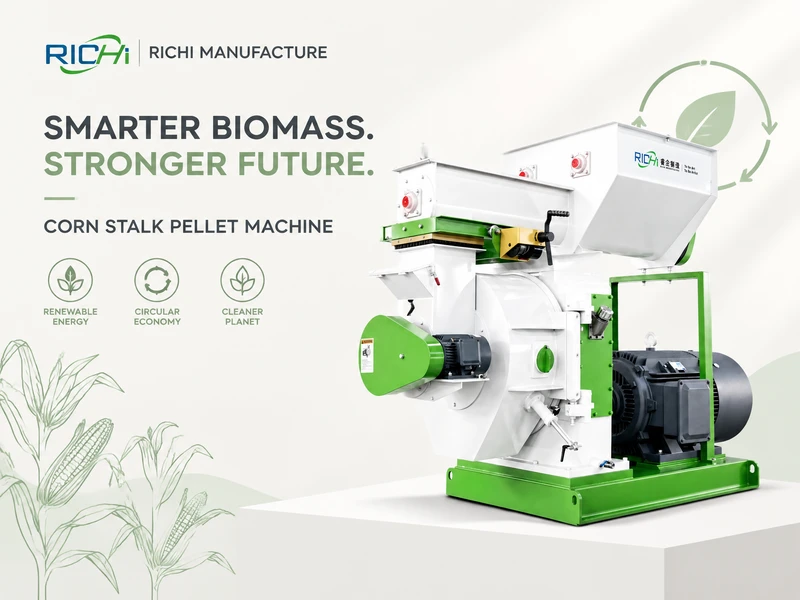
Corn production generates large quantities of stalks that can become difficult to store or dispose of after harvesting. Instead of treating these residues only as waste, agricultural businesses can investigate ways to convert them into useful products. A corn stalk pellet machine provides one such solution by compressing prepared stalk fibers into dense pellets.
The broader concept becomes more interesting when corn stalks are considered as one component of a diversified biomass feedstock strategy.
Corn Stalk Is Only One Possible Feedstock
A modern biomass pellet project does not always need to depend on a single agricultural residue. Depending on local availability and the intended product, corn stalks may be processed alongside wheat straw, rice husks, grass, sawdust, or other compatible materials.
This flexibility can help businesses maintain production when one seasonal feedstock becomes less available.
However, mixing materials should not be done simply because they are available. Differences in moisture, particle size, ash characteristics, fiber structure, and intended product can influence pellet quality.
Fuel Is One Important Application
Biomass fuel is a major reason agricultural residues are pelletized. Loose straw is bulky and difficult to transport economically over long distances. Compression increases bulk density and creates a standardized product.
For users operating heating systems or biomass boilers, uniform pellets can simplify storage and feeding compared with irregular loose residues.
The economic benefit depends on local energy prices and logistics. A pellet producer located close to both raw material suppliers and energy users may have a significant transportation advantage.
Feed and Agricultural Uses
Corn stalks also contain fiber and can be incorporated into certain animal feed formulations. However, feed production has different technical requirements from fuel pellet production. Conditioning, formulation, hygiene, nutritional targets, and pellet durability all need to be considered.
Agricultural residues may also be processed for soil-related applications. Organic matter from crop residues can contribute to soil improvement, and pelletized products can be easier to transport and apply than loose material.
Anonymous sources can sometimes provide general market discussions, but equipment decisions should ultimately rely on technical information related to the actual raw material and production objective.
Why Equipment Configuration Matters
A biomass straw pellet machine is not necessarily a universal solution for every application. The same basic pelletizing technology may require different supporting equipment depending on whether the final product is fuel, feed, or fertilizer.
Fuel projects may focus on drying, high-density compression, cooling, and storage. Feed projects may require conditioning and more controlled formulation. Fertilizer projects may have their own mixing and granulation requirements.
This is why the end product should be established before equipment is selected.
Combining Agricultural and Forestry Residues
In some markets, agricultural residues are seasonal while forestry residues are available for longer periods. A diversified biomass business may therefore investigate compatible feedstocks to improve annual equipment utilization.
A wood pellet machine, for example, is designed around a different raw material group, but a broader biomass processing strategy can include both agricultural and forestry residues where equipment configuration and product requirements allow.
The key is to understand the material properties instead of assuming that all biomass behaves identically.
Making Better Use of Local Resources
The strongest biomass opportunities are often connected to local resource patterns. A region with extensive corn farming, livestock operations, and industrial energy users may have several possible markets for processed biomass.
Instead of transporting low-density stalks over long distances, local pellet production can create a more compact commodity. This can make storage and transportation more manageable while creating an additional use for agricultural residues.
From Waste Management to Resource Management
Pelletizing should not be viewed only as a machine purchase. It is a resource-management strategy that connects agricultural residues with markets for energy, feed, or agricultural products.
With proper raw material preparation, equipment selection, and process control, corn stalks can become a much more manageable material. The result is a potential business opportunity built around resources that would otherwise have limited commercial value.
view details: https://www.richimanufacture.com/straw-pellet-machine-for-sale/